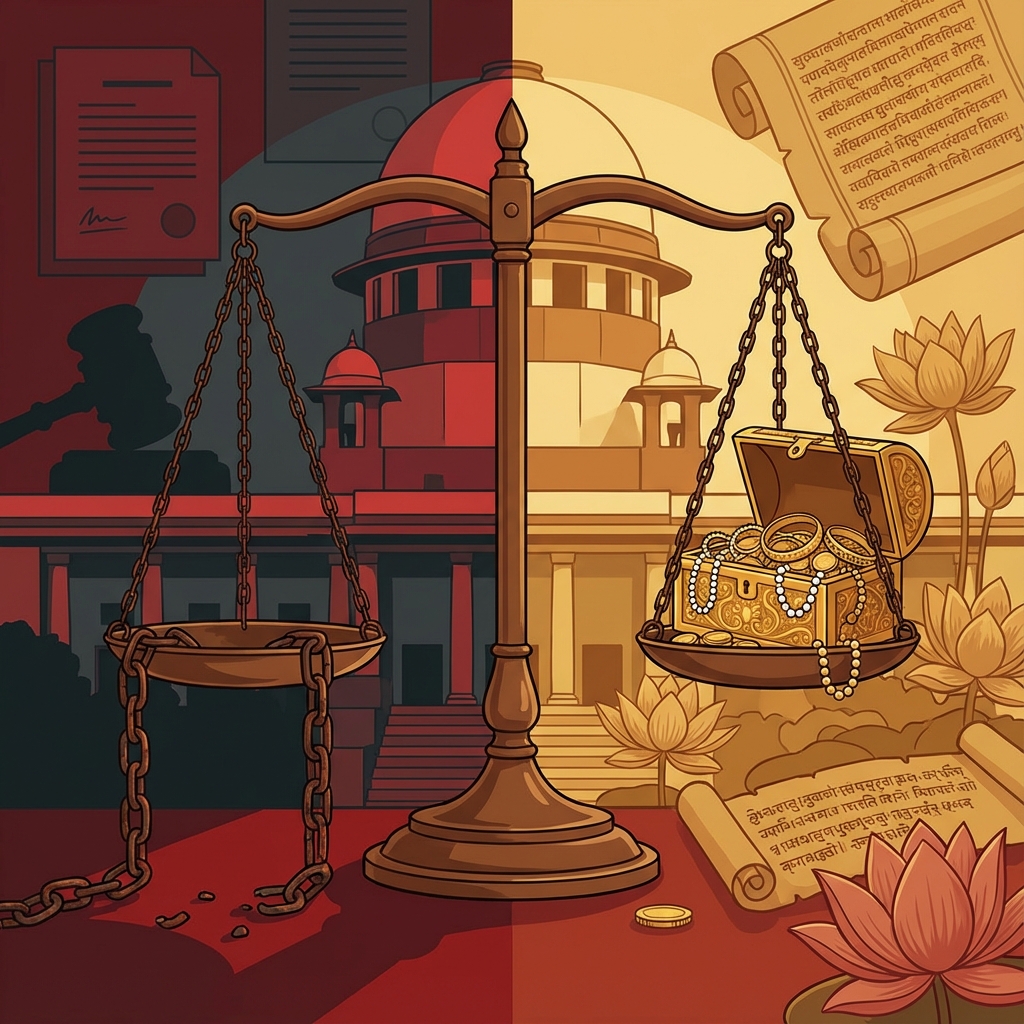
Key Takeaway: Dowry is ILLEGAL and benefits the groom's family. Streedhan is LEGAL and belongs entirely to the bride. Knowing this difference protects your rights.
What is Dowry? (Illegal)
Dowry refers to any property or valuable security demanded by the groom's side as a condition or consideration for marriage.
Key Characteristics of Dowry:
- It is demanded by the groom or his family
- It is given as a condition for the marriage to happen
- It is given to the groom or his family, not to the bride
- There is often coercion or pressure involved
- It continues even after marriage ("more dowry" demands)
⚠️ Dowry is a Crime
Under the Dowry Prohibition Act, 1961, giving, taking, or demanding dowry is punishable by:
- Minimum 5 years imprisonment
- Minimum fine of ₹15,000 or the value of dowry (whichever is higher)
What is Streedhan? (Legal)
Streedhan (literally "woman's wealth") refers to gifts given voluntarily to the bride by her parents, relatives, or friends – before, during, or after marriage.
Key Characteristics of Streedhan:
- Given voluntarily without any demand or pressure
- Given directly to the bride as her personal property
- Given out of love and affection, not as a condition of marriage
- Remains the bride's absolute property forever
- Husband and in-laws have no legal right over it
✅ Streedhan is Protected by Law
If a husband or in-laws take away a woman's streedhan, she can file a criminal case under Section 406 IPC (criminal breach of trust) to recover it.
Dowry vs Streedhan: Comparison Table
| Aspect | Dowry (Illegal) | Streedhan (Legal) |
|---|---|---|
| Legal Status | ❌ Criminal offense | ✅ Protected property right |
| Nature | Demanded, coerced | Voluntary, given with love |
| Recipient | Groom or his family | Bride only |
| Ownership | Usually taken by in-laws | Bride's absolute property |
| Timing | Condition for marriage | Before, during, or after marriage |
| Who Can Give | Usually bride's parents (under pressure) | Anyone – parents, siblings, friends, relatives |
| After Divorce | Often kept by groom's family | Must be returned to bride |
| Penalty if Taken | Dowry Prohibition Act applies | Section 406 IPC (breach of trust) |
What Counts as Streedhan?
Streedhan includes a wide range of gifts and property:
- Jewelry and ornaments given to the bride
- Cash gifts given directly to her
- Clothes and personal items
- Property or assets in her name
- Gifts from her own family (parents, siblings, relatives)
- Gifts from the groom's family given TO HER directly
- Gifts from friends
- Gifts received during Hindu rituals like Baarat, Samagri, or Bhaat
Important: Intent and Control Matter
The key distinction is whether the gift was:
- Given voluntarily vs demanded
- Given to the bride vs given to groom/in-laws
- Controlled by the bride vs taken by in-laws
How Courts Distinguish Dowry from Streedhan
Indian courts have established several precedents:
Supreme Court Rulings:
- Pratibha Rani vs Suraj Kumar (1985): Established that streedhan is the absolute property of the wife, and any misappropriation is a criminal offense.
- Rashmi Kumar vs Mahesh Kumar Bhada (1997): Clarified that husband/in-laws are only "trustees" of streedhan and cannot use it without wife's consent.
Key Legal Principles:
- Streedhan given to the bride becomes her exclusive property
- Husband has no claim over wife's streedhan, even during marriage
- If streedhan is misappropriated, the wife can file criminal charges
- Upon divorce or separation, streedhan must be returned to the wife
Protecting Your Streedhan: Practical Tips
Before Marriage:
- Document all gifts you receive with photos and receipts
- Keep a written list of all jewelry with descriptions and weight
- Get gifts appraised and documented
- Store important items in a bank locker in YOUR name
During Marriage:
- Keep streedhan in your personal possession when possible
- Don't hand over control to in-laws
- Maintain records of any items given to in-laws for "safekeeping"
- Keep copies of all documentation at your parents' house
If Streedhan is Taken:
- File a complaint under Section 406 IPC
- Mention streedhan in domestic violence complaints
- Include streedhan recovery in divorce proceedings
- Get legal help from a family lawyer
Common Questions About Streedhan
Can my husband sell my streedhan?
No. Your husband has no legal right to sell, mortgage, or dispose of your streedhan without your explicit consent. Doing so is a criminal offense.
What if my in-laws "borrowed" my jewelry?
They are legally bound to return it. If they refuse, you can file a criminal case for breach of trust (Section 406 IPC).
Does streedhan become joint property after marriage?
No. Streedhan remains your exclusive property throughout your life, regardless of how long you've been married.
What happens to streedhan after divorce?
It must be returned to you in full. Courts routinely order the return of streedhan in divorce proceedings.
Conclusion: Know Your Rights
Understanding the difference between dowry and streedhan is crucial for every Indian woman:
- Never agree to dowry demands – they're illegal
- Protect your streedhan – it's your legal right
- Document everything – keep records of all gifts
- Seek legal help if your streedhan is misappropriated
Expose the Absurdity of Dowry
Use our Dowry Calculator to see how ridiculous it is to put a price on marriage – then share to raise awareness.
Try the Dowry Calculator